
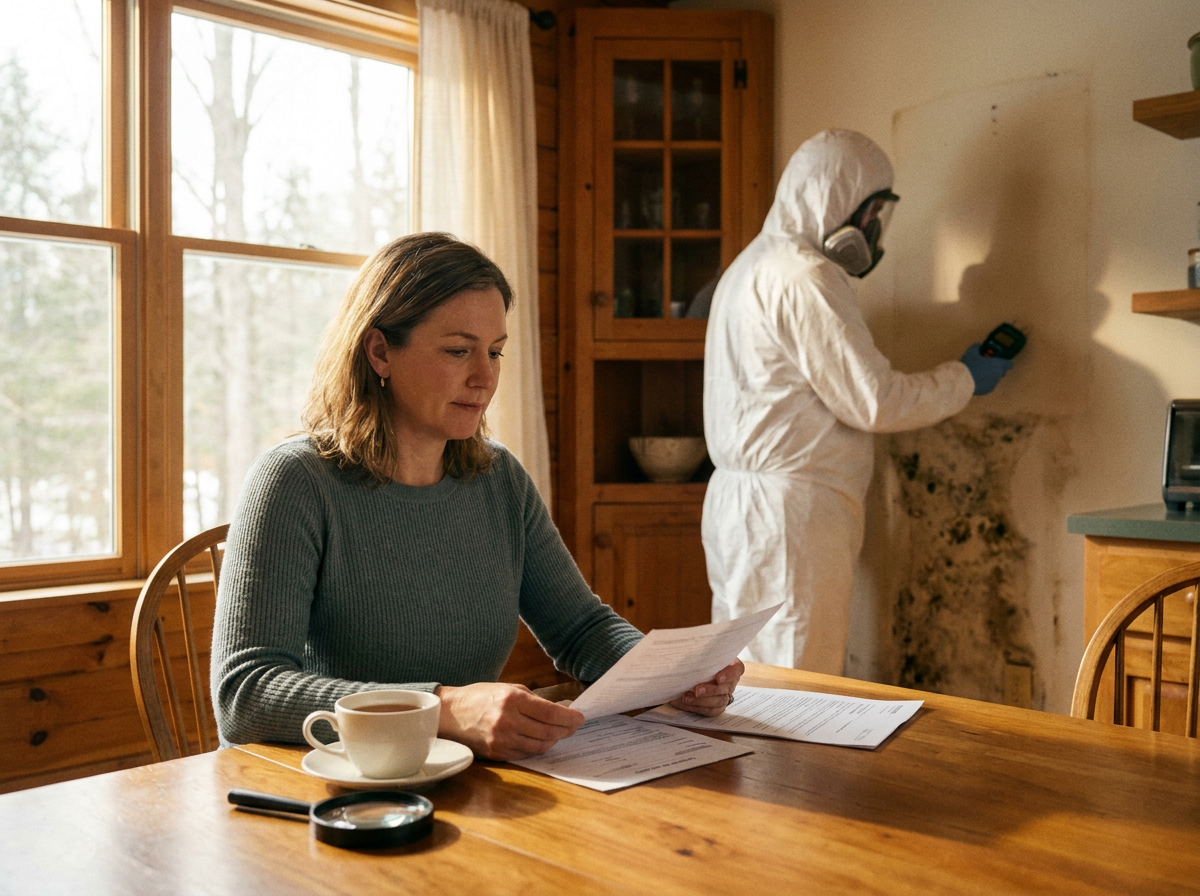
The key question insurers ask: Did the mold result from a sudden, accidental covered event — or from gradual moisture, deferred maintenance, or neglect? The answer to that question determines whether your policy responds. This guide walks through both scenarios, what documentation you need, and how to work the process correctly from the start.
Mold is one of the most common and costly problems in Northern New York homes. The region's harsh winters, wet springs, high humidity, and aging housing stock create near-ideal conditions for mold growth — and when it takes hold inside a wall cavity, under a floor, or in an attic, professional remediation is the only safe answer. The question most homeowners ask immediately: who pays for it?
Insurance coverage for mold remediation in New York is more nuanced than a simple yes or no. It depends on your specific policy, the cause and source of the moisture that led to the mold, how long the mold has been present, and whether you can document a covered event as the origin. At Post Trauma Scene Decon, we are IICRC-certified for mold remediation across St. Lawrence, Franklin, Clinton, Essex, Lewis, and Jefferson counties — and we have navigated the insurance documentation process with virtually every major carrier serving the region. Here is what we have learned.
The Core Rule: Sudden vs. Gradual
Standard homeowners insurance policies — including HO-3 policies, which cover most owner-occupied homes in New York — are designed to protect against sudden and accidental losses. They are not designed to cover gradual deterioration, neglect, or conditions that developed over time without action.
This distinction is the single most important factor in any mold coverage decision:
Sudden + accidental = often covered
Mold that results directly from a covered sudden event — a burst pipe, an appliance failure that flooded a room, a roof collapse from an ice dam, a fire suppression response — is typically covered as part of the underlying water damage claim. The mold is treated as consequential damage from the covered event.
- ✓Burst pipe (freeze damage)
- ✓Sudden appliance leak (dishwasher, washing machine)
- ✓Roof damage from wind, hail, or ice dam collapse
- ✓Fire suppression water damage
- ✓Vandalism-related water intrusion
Gradual + maintenance = typically not covered
Mold that developed over weeks, months, or years from chronic moisture — poor ventilation, a slow drip that went unaddressed, condensation from thermal bridging, basement humidity — is generally treated as a maintenance issue and excluded from coverage.
- ✗Chronic basement dampness / seepage
- ✗Long-term roof leak not from a sudden event
- ✗HVAC condensation buildup
- ✗Poor bathroom ventilation over time
- ✗Deferred maintenance of any kind
This framing matters because most mold discoveries are not clean-cut. A homeowner finds mold behind a bathroom wall — was it a slow drip from a supply line, or did the tile grout fail gradually? The adjuster's job is to determine origin; your job is to document the sudden covered event if one exists.
New York State and Mold: What the Law Says
New York State has specific requirements governing how insurance companies handle mold-related claims. The New York State Department of Financial Services (DFS) regulates insurance policy language and requires that any exclusion for mold be clearly stated in the policy — insurers cannot simply invoke a blanket denial without identifying the specific exclusion.
Additionally, New York has one of the most comprehensive mold remediation regulatory frameworks in the country. The NYS Department of Labor mold program requires that anyone conducting mold remediation on a project above 10 square feet must hold a current NYS DOL mold license. This requirement exists because large-scale mold remediation carries significant health risks — disturbing mold colonies without proper containment can spread spores throughout a home and cause respiratory harm.
We hold current NYS DOL mold certification, renewed on the required schedule. When your insurer receives our documentation, they see a licensed, certified company — which reduces friction in the claims process.
When Homeowner's Insurance Typically Covers Mold Remediation
Scenario 1: Burst Pipe or Plumbing Failure
A frozen pipe bursts in February — common in North Country homes every winter. Water floods a bathroom and adjacent wall cavity. You call a plumber, stop the water, and within a week, mold begins growing in the wet drywall and insulation.
This is the strongest insurance scenario. The cause is a sudden, accidental covered event (the burst pipe). The mold is a direct consequence. Most HO-3 policies will cover both the water damage and the resulting mold remediation as part of the same claim. The key is acting quickly — insurers look unfavorably on situations where mold had time to spread significantly before action was taken.
Scenario 2: Appliance Failure
A dishwasher supply line fails suddenly and saturates the kitchen sub-floor. Or a washing machine hose fails in the laundry room. The water damage and resulting mold in the affected area are typically covered, provided you can document the sudden failure as distinct from a slow leak that went unaddressed.
Scenario 3: Roof Damage from a Covered Event
A wind event removes roofing material or an ice dam collapses, allowing water intrusion into the attic. Mold follows in the saturated insulation and sheathing. If the roof damage was from a covered peril (wind, hail, weight of ice and snow in many policies), the mold remediation in the attic is typically covered as consequential damage.
Scenario 4: Fire Suppression
A kitchen fire is suppressed with water. The water saturates walls and ceilings, and mold grows in the affected areas within days. Mold remediation as part of the fire damage restoration is almost universally covered under fire and smoke damage provisions.
When Insurance Typically Does NOT Cover Mold
Flood water from outside the home
Excluded under HO-3Standard homeowner's insurance does not cover flooding from surface water — rivers, heavy rain runoff, storm surge. Mold resulting from a flood event requires flood insurance, which is a separate policy (typically through FEMA's National Flood Insurance Program). Many North Country homeowners in flood-prone areas have this coverage; many do not.
Gradual moisture and maintenance-related mold
Excluded as maintenanceMold that developed over months or years from a slow leak under a sink, chronic basement seepage, or inadequate ventilation is almost universally excluded as a maintenance failure. Insurers can and do hire forensic investigators to determine origin and timeline.
Mold pre-existing at time of purchase
Not a covered eventIf mold was present when you purchased the home, it is not a covered loss under your policy — it is a defect in the property you assumed when you bought it. This is typically a seller disclosure issue rather than an insurance claim.
Mold in a vacant property
Check vacancy clauseMany policies include vacancy clauses — if the home was unoccupied for 30, 60, or 90 days (depending on the policy), coverage for water damage and mold may be suspended or excluded. In Northern New York, seasonal properties and vacation homes are particularly vulnerable to this exclusion.
Renter's Insurance and Mold: What Tenants Should Know
Renters face a different situation. A renter's insurance policy (HO-4) covers the tenant's personal property and liability — it does not cover the building structure, which is the landlord's responsibility.
If mold damages a tenant's personal property — clothing, furniture, electronics — coverage under a renter's policy may apply, depending on the cause. If the landlord was negligent in addressing a known moisture problem that led to mold, the tenant may have a negligence claim against the landlord rather than an insurance claim.
For renters in North Country New York dealing with mold in a rental unit, the first call should be to the landlord, followed by a written, dated notification so you have a record. If the landlord fails to act, the NYS Division of Housing and Community Renewal (DHCR) and local code enforcement are the next steps.
The NYS Landlord-Tenant Handbook outlines tenant rights regarding habitability — which includes being free from conditions that endanger health, mold being among them.
Landlord and Rental Property Insurance
Landlords and property managers dealing with mold in a rental property are covered under dwelling fire or landlord policies rather than standard homeowner's policies. The same sudden-vs.-gradual rule applies, but there are additional considerations:
- •Tenant-caused mold (from misuse of the property, failure to ventilate, etc.) may be covered under the policy's vandalism or malicious damage provisions, or may be a tenant liability matter
- •Mold discovered after a tenant vacates — particularly in hoarding or neglect situations — typically requires documentation of the tenant's actions to establish cause
- •Property managers should document move-in and move-out conditions thoroughly to establish baseline and support any insurance claim
We work with property managers and landlords regularly and understand the documentation requirements for rental property insurance claims. See our related post on what property managers need to know about biohazard cleanup for a broader overview of how insurance intersects with remediation in rental properties.
How to File a Mold Remediation Insurance Claim: Step by Step
If you believe your mold remediation may be covered, here is how to approach the claims process to give yourself the best chance of a successful outcome.
Document the moisture source immediately
Before any repair or cleanup begins, photograph and document the source of the water intrusion. The burst pipe, the failed appliance, the damaged roof — this is the evidence your insurer needs to establish a covered cause. If a plumber or roofer responds first, ask them to document their findings in writing.
File your claim promptly
Contact your insurer as soon as the water event occurs — not after mold is discovered. Delayed reporting gives adjusters grounds to question whether the damage occurred as described and whether you mitigated promptly. Many policies require prompt notice of loss.
Take reasonable mitigation steps
Your policy likely requires you to take reasonable steps to prevent further damage after a covered event — stopping the water source, ventilating, removing standing water. Failing to mitigate can reduce or void coverage. Keep receipts for any emergency mitigation costs.
Do not fully remediate before the adjuster inspects
For insurance-covered jobs, wait for adjuster inspection before major remediation begins. You can do emergency mitigation (stop water, ventilate, remove wet materials posing immediate health risk), but do not remove all mold evidence before the adjuster has documented it. This is often where claims go wrong.
Get a certified remediation company involved early
We can provide a preliminary assessment and scope documentation that supports your claim before the adjuster arrives. Our IICRC certification, NYS DOL license, and professional documentation format are recognized by adjusters and reduce disputes about scope and cost.
Request a mold-experienced adjuster
Standard property adjusters may not have deep familiarity with mold remediation scope and pricing. Ask your insurer to assign an adjuster with experience in this type of claim, or to consult with a mold specialist during the review. In North Country NY, expect 30–45 day approval timelines with major out-of-area carriers.
We handle the documentation package
Once we are engaged, we provide: detailed photographic documentation of affected areas, itemized scope of work with IICRC standard citations, moisture readings and affected area measurements, chain-of-custody records for all disposed materials, and a clearance report on completion. This is the package adjusters need to close the claim.
What If My Claim Is Denied?
A mold claim denial is not necessarily final. In New York, you have the right to appeal an insurer's coverage decision and to file a complaint with the NYS Department of Financial Services if you believe the denial was improper.
The Cost of Mold Remediation in Northern New York — With and Without Insurance
Understanding what remediation costs helps you evaluate whether filing a claim is worth the potential premium impact. Our full breakdown is in our post on mold remediation cost per square foot in New York. A summary:
| Scope | Typical Range | Insurance Relevance |
|---|---|---|
| Small bathroom / localized (under 10 sq ft) | $500 – $1,500 | Below most deductibles — may not be worth claiming |
| Single room (10–100 sq ft) | $1,500 – $4,000 | Worth evaluating against deductible and history |
| Multiple rooms / wall cavities | $4,000 – $10,000 | Strong candidate for insurance claim |
| Whole-attic or crawlspace remediation | $3,000 – $8,000 | Often covered if tied to a covered roof or moisture event |
| Whole-home / extensive structural | $10,000 – $30,000+ | Insurance coverage is critical — document origin carefully |
We price mold remediation at $12/sq ft flat rate for standard residential remediation in Northern New York — transparent, documented, and consistent with IICRC scope standards. This makes it easy for adjusters to evaluate and for homeowners to compare.
Why Mold Must Be Professionally Remediated — Not Painted Over
Insurance adjusters sometimes try to limit scope by suggesting surface treatments rather than proper remediation. This is worth resisting — not just for your health, but because surface-only treatment of mold does not satisfy IICRC remediation standards, and an insurer who approves a surface treatment and later faces a mold recurrence claim may dispute responsibility.
Proper mold remediation per IICRC S520 standards requires:
- •Containment of the work area with poly sheeting and negative air pressure
- •Removal of all mold-contaminated porous materials (drywall, insulation, wood framing if affected)
- •HEPA vacuuming of all surfaces in the containment area
- •Application of EPA-registered antimicrobial treatment to all cleaned surfaces
- •Application of preventive mold-inhibiting coating (RMR-141 or equivalent) on structural surfaces
- •Air clearance testing to confirm contamination has been reduced to background levels
Painting or bleaching over mold does not remove it — it hides it. The mold continues growing behind the paint. Insurance companies that understand the standard (and adjusters familiar with mold claims do) will not dispute a proper scope.
Frequently Asked Questions
Does homeowners insurance cover mold from a burst pipe?
Yes, in most cases. Mold that results directly and promptly from a burst pipe — a covered sudden event — is treated as consequential damage from the underlying water loss. The key is acting quickly: document the pipe failure, stop the water, and file the claim before significant mold develops.
My policy has a mold exclusion. Does that mean I have no coverage?
A mold exclusion limits direct mold coverage but does not necessarily eliminate it when mold results from a covered event. Many policies with mold exclusions still pay for mold remediation when it is consequential to an otherwise covered loss (burst pipe, fire suppression). Read the exclusion carefully and call your agent for clarification.
Will filing a mold claim raise my insurance rates?
A single water-related claim may result in a modest rate increase at renewal, depending on your carrier and claims history. In areas prone to freeze damage (all of North Country NY), many carriers already price this risk into your premium. Whether to file depends on the cost relative to your deductible and your specific policy history — your agent can give you a candid assessment.
How long does the insurance approval process take?
In Northern New York, major out-of-area carriers (State Farm, Allstate, Erie, etc.) typically take 30–45 days from claim filing to remediation approval. Local and regional carriers often move faster. We work directly with adjusters and can accelerate this timeline by providing complete documentation upfront.
Do I need to hire a mold inspector before calling you?
No. We assess the scope during our on-site evaluation and provide the documentation adjusters need as part of our engagement. A separate mold inspector is generally not required and adds cost without adding adjuster-relevant information. If your insurer specifically requires an independent air quality test for clearance purposes, we can coordinate that.
What if my deductible is higher than the remediation cost?
If your deductible exceeds the remediation cost, filing a claim is not in your financial interest — the claim goes on your record and you pay out of pocket anyway. We will give you an honest estimate before you make any decision about whether to file. For smaller jobs, self-pay with our payment plan option is often the cleaner path.
Documentation we provide for every mold remediation claim:
- ✓Photographs of affected areas before, during, and after remediation
- ✓Moisture meter readings establishing extent and depth of contamination
- ✓Itemized scope of work with IICRC S520 standard citations
- ✓NYS DOL mold license documentation
- ✓Chain-of-custody records for all disposed materials
- ✓Post-remediation clearance documentation
About Post Trauma Scene Decon
We are the only certified biohazard and mold remediation company in Northern New York founded and led by a service-disabled veteran and former police officer and crime scene technician. We hold IICRC mold remediation certification, NYS DOL and DEC licensing, OSHA compliance, BBB accreditation, and SDVOB and HUBZone certification. We are the 2025 BBB Torch Award for Ethics recipient. We serve St. Lawrence, Franklin, Clinton, Essex, Lewis, and Jefferson counties and respond 24/7. Our flat-rate mold pricing ($12/sq ft) makes estimates easy for homeowners and adjusters alike.
"The insurance question comes up on almost every mold job. My advice is always the same: call your agent, document the source, and do not let uncertainty about coverage stop you from addressing the mold promptly. Delay almost always makes both the mold problem and the coverage situation worse." — James Smith, Founder
Post Trauma Scene Decon provides mold remediation and biohazard cleanup across St. Lawrence, Franklin, Clinton, Essex, Lewis, and Jefferson counties in Northern New York. IICRC certified. NYS DOL licensed. OSHA compliant. BBB accredited. SDVOB and HUBZone certified. 2025 BBB Torch Award for Ethics.
Mold Problem? We Can Help With the Remediation and the Insurance.
We assess every job on-site and provide complete insurance documentation as part of our service. Call us to schedule an assessment — available 24/7 across North Country NY.
Call (315) 288-3670